
Contain at-risk devices without destroying data
Device Containment instantly restricts access to at-risk devices and data while preserving visibility and control — and is fully reversible once the incident is resolved.
to first response
data destroyed
on resolution
Device compromise is a certainty. Remote wipe is a poor response.
With hundreds or thousands of endpoints in the field, loss, theft, and compromise aren't rare exceptions — they're a routine, high-volume category of incident.
For years, the default response has been remote wipe — a legacy answer that destroys data, delays response, and eliminates the visibility that matters most during an active incident.
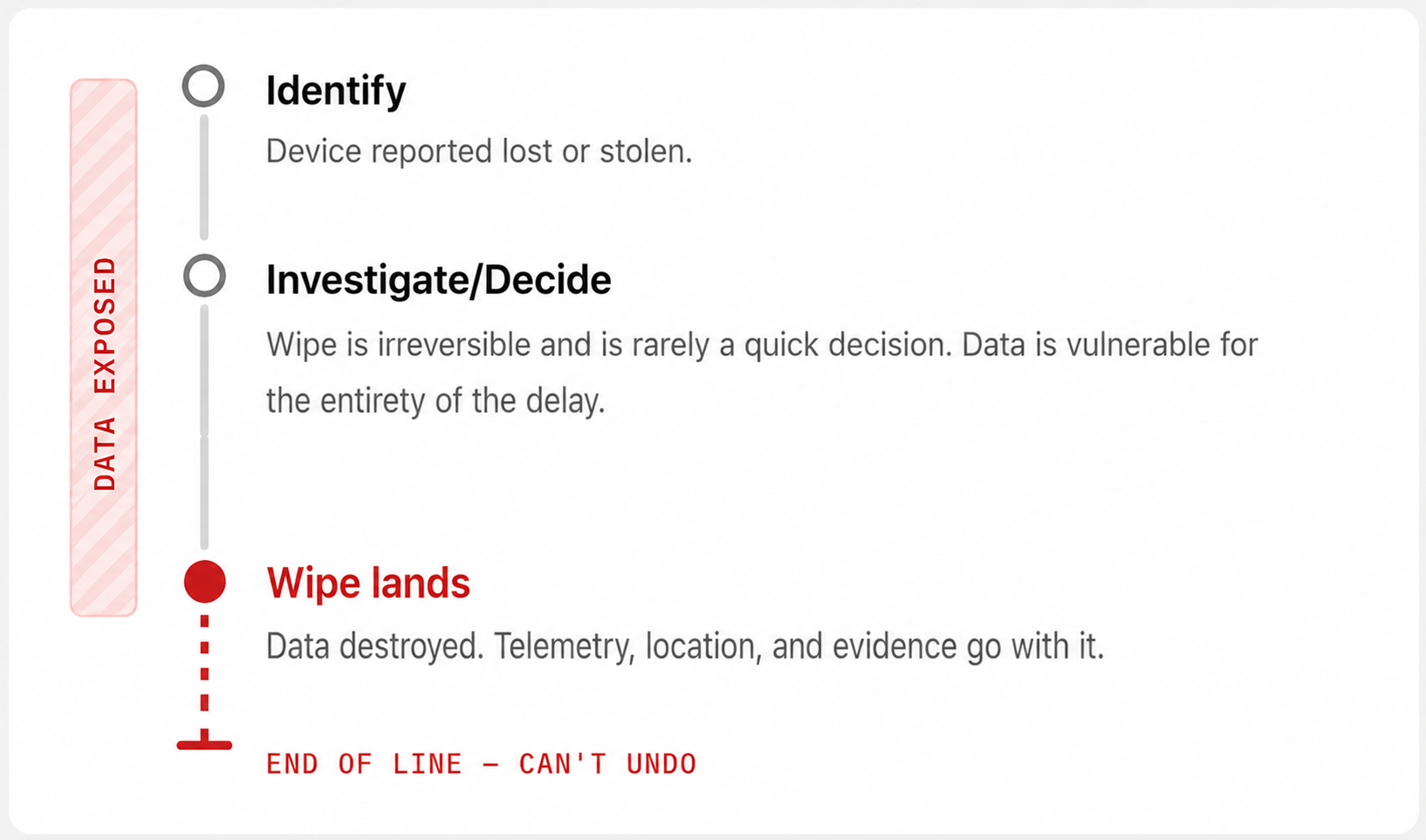
Protection without destruction
Containment turns device incident response into a repeatable and non-destructive operation: restrict access instantly, keep the device visible and controllable for the whole lifecycle, and unwind cleanly when the incident closes — the same way every time, on one device or a thousand.
Instant containment
Restrict access in seconds without destroying a single byte.
Continuous visibility
Keep location, hardware, and containment state through the whole incident.
Flexible resolution
Reauthorize, hold, or write off — decided with facts, not guesses.
Automatic protection, on every shift
Contain a laptop the moment it crosses into a no-go zone, or a desktop the moment it leaves its assigned facility. Have devices self-contain when they've been dark too long. Containment gives your SOC a response that fires without an analyst in the loop.
Geofence triggers
Define restricted areas — borders, competitor sites, high-risk regions — and contain devices that enter them. Or contain assets that leave an assigned facility without authorization.
Offline curfew
Devices that go dark longer than policy allows contain themselves — locally, with no connectivity required.
Location spoofing detection
Contain devices attempting to mask their true location via VPN, proxy, or GPS manipulation.
Offline Curfew enforced containment within seconds of the threshold — no analyst in the loop.
An employee-assigned laptop was not returned following a regional reduction-in-force.
Device Containment was automatically enforced within seconds of the Offline Curfew threshold, immediately restricting local access while preserving visibility and administrative control.
The device remained protected throughout the investigation and was ultimately recovered without data loss or destructive action.
What a modern response looks like
Remote wipe makes you choose between waiting and destroying. Containment removes the dilemma and accelerates your response.
The foundation of your endpoint security stack
Your current endpoint stack secures software, identities, and access. Containment secures the layer beneath them all — the physical device.
IDP · FIREWALL · EMAIL SECURITY
EDR · MDM · PATCH MANAGEMENT


Device Containment FAQ
Wiping requires certainty about who has the device, whether it will be returned, and what data or evidence disappears with it. That need for certainty is what delays action — and the device stays at risk the whole time.
It combines device access controls with Emergency Encryption to restrict access to data immediately while preserving visibility, recovery options, and administrative control. As the incident evolves you can recover, reauthorize, or write off the device.
Policies such as Offline Curfew are enforced locally on the device and need no connectivity. Controls that depend on external context, like geofences, are enforced when the device reconnects.
No. Containment reduces manual decision-making by enforcing predefined response policies automatically.
No. MDM handles device administration and policy management. Containment enables immediate, policy-based control of at-risk devices, extending security to the physical layer — beyond software, identities, and access.
Stop choosing between waiting and wiping.
Contain your first at-risk device in minutes. No destructive commands required.