BEYOND REMOTE WIPE
Secure at-risk devices without destroying data
Device Containment instantly restricts access while preserving visibility and control — without the delay and uncertainty of remote wipe.
Device Containment instantly restricts access while preserving visibility and control — without the delay and uncertainty of remote wipe.

For years, organizations have used remote wipe to secure lost, stolen, and otherwise at-risk devices. Because it destroys data, remote wipe introduces response delays and uncertainty, and eliminates visibility that may be critical during an active incident.
Remote wipe introduces response delays and forces a destructive action
Remote wipe offers no middle ground between inaction and destruction, limiting flexibility as an incident unfolds.
Remote wipe is irreversible, so teams often delay using it while assessing risk and gathering information.
Sensitive data remains accessible while teams assess, confirm, and decide how to respond.
Remote wipe depends on the device reconnecting and receiving the command.
Device location, status, and activity can no longer be monitored after a wipe is executed.
A centralized wipe capability can create significant organizational risk if misused, compromised, or triggered unintentionally.
Instantly restrict access to at-risk data and devices while maintaining visibility and control throughout the incident lifecycle. Containment is fully reversible once an incident is resolved.
Restrict access immediately without destroying data.
Maintain control and visibility throughout the incident.
Reauthorize or continue containment as the incident warrants.

Initial response
Action type
Control during incident
Visibility
Reversibility
Command delivery
Operational flexibility
Business outcome
Delayed by assessment
Destructive
Lost after wipe
Lost after wipe
None
Requires device reconnect
Single irreversible path
Device untraceable, exposure status unknown
Immediate control
Non-destructive
Continuous control
Fully retained
Fully reversible
Policy-driven execution
Multiple resolution paths
Device traceable, recovered, or safely written off
Remote wipe forces organizations to choose between waiting for more information or destroying data immediately. Device Containment restricts access instantly while preserving visibility, improving both response and recovery outcomes.
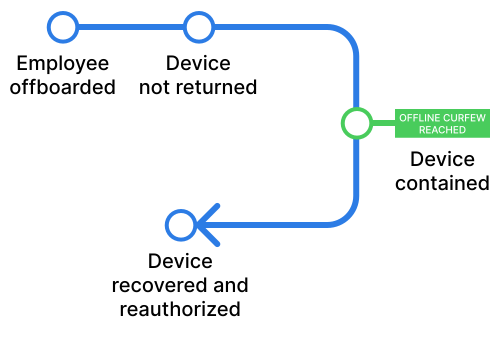
Unreturned devices often remain in limbo after employee departures. Device Containment maintains control of corporate data until the device is returned, recovered, or formally written off, reducing operational and compliance risk.
Devices can stop reporting due to connectivity issues, tampering, or attempts to evade management controls. Device Containment allows organizations to maintain a security posture for at-risk devices without relying on immediate connectivity or destructive actions.
When a device appears in an unexpected country, facility, or network, organizations may need time to investigate without exposing data. Device Containment restricts access immediately while preserving visibility into the device's status and location.
When device behavior indicates elevated risk, organizations need immediate control without disrupting investigations. Device Containment limits access while preserving visibility, enabling informed response and remediation.
Incident:
An employee-assigned laptop was not returned following a regional reduction-in-force.
Response:
Device Containment was automatically enforced within seconds of Offline Curfew threshold, immediately restricting local access while preserving visibility and administrative control.
Outcome:
The device remained protected throughout the investigation and was ultimately recovered without data loss or destructive action.
Device Containment complements existing MDM, EDR, and IAM investments by adding an incident response layer for at-risk devices.
Works alongside MDM, EDR, IAM
Does not replace existing tools
Adds a control layer for at-risk endpoints
Extends security to the physical layer of data and devices
Results in a secured device fleet
applied to physical device
locked, restricted and visible
Remote wipe requires certainty about who has the device, whether it will be returned, and what data or evidence may be lost. This need for certainty often delays action while the device remains at risk.
Device Containment combines device access controls with out-of-band encryption to immediately restrict access to at-risk devices while preserving visibility, recovery options, and administrative control. Organizations can recover, reauthorize, or write off devices as incidents evolve.
Selected containment policies, such as Offline Curfew, are enforced locally on the device and do not require connectivity. Other controls that depend on external context, such as geofences, are enforced when the device reconnects.
No. Containment reduces manual decision-making by enforcing predefined response policies automatically.
No. MDM and Secure Containment serve different purposes. MDM focuses on device administration and policy management, while Secure Containment enables immediate, policy-based control of at-risk devices. It extends security to the physical layer of devices, beyond software, identities, and access.
See where response delays, data loss, and visibility gaps exist in your current process, and whether Secure Containment is the right fit.
What you’ll get:
Assessment of where remote wipe introduces response delays, data loss, or visibility gaps
Evaluation of whether Secure Containment would improve outcomes in your environment
Practical recommendations for modernizing your endpoint response processof gaps in your current response process